
Guide
The best vitamin D3 + K2 supplements compared (2026)
Last updated: 6 August 2026

Written by
Health Tested Editorial Team
Vitamin D3 and K2 make an unbeatable team: they complement each other and work together in many of your body's processes.
Each of these vitamins already plays an important role on its own, but they only show their true strength in combination. From strengthening bones and teeth and supporting the immune system to promoting healthy cardiovascular function, vitamin D3 + K2 proves a powerful duo with a range of impressive health benefits.
Vitamin D is one of the most important vitamins for your body, and doctors often recommend taking it.
But which vitamin D product is right for you?

There are countless vitamin D supplements on the market, but not all of them are effective.
The sunshine vitamin
Vitamin D, often called the 'sunshine vitamin', plays a crucial role in your health. It's a fat-soluble vitamin that your body produces naturally when your skin is exposed to sunlight.
Vitamin D supports the absorption of calcium and phosphorus, which in turn matters for healthy bones and teeth. It influences a wide range of bodily functions and supports a healthy metabolism. It also contributes to strengthening the immune system, supports muscle strength and has a positive effect on mood.
The sun is the main source of vitamin D, but it can be hard to get enough sunlight, especially in certain regions or during the winter months.
Your diet won't make up the shortfall either: most foods contain only small amounts of vitamin D.
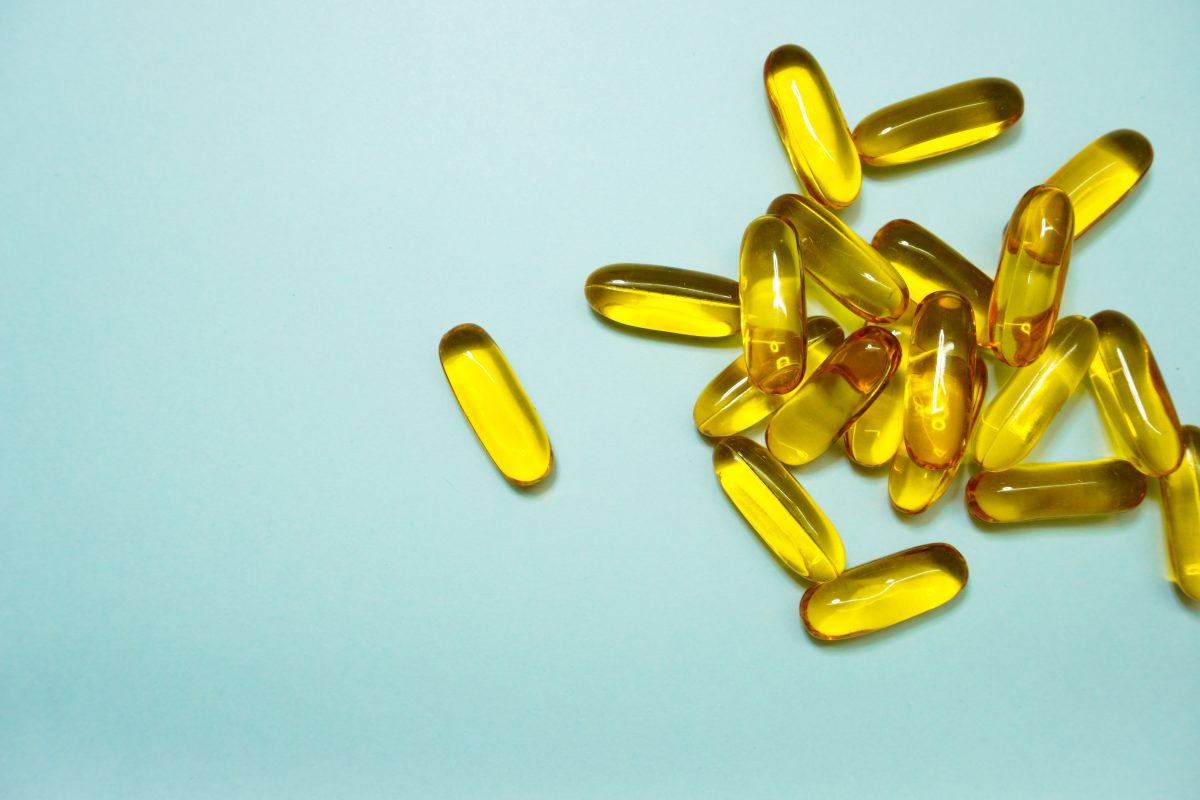
'Vitamin D deficiency is a silent epidemic of the modern world and affects up to 50% of the population.' (Dr Michael F. Holick)
The problem with vitamin D
Vitamin D deficiency is one of the most widespread vitamin deficiencies in the world, and in Germany, too, more than a third of the population is affected.
The reason: too little sun. This far north, sunlight is often not strong enough to ensure an optimal supply. Even on sunny days, your body often doesn't produce enough vitamin D to meet its needs. Then there's our modern lifestyle. Many of us spend most of the day indoors, whether at home or at a desk. As a result, we often miss out on the natural sunlight needed to produce vitamin D in sufficient amounts.
In winter especially, and when you spend long periods indoors, your blood vitamin D level can fall further and make the deficiency worse.
In regions with less sunshine, rates of seasonal depression often rise in winter. This is mainly linked to vitamin D deficiency. The vitamin plays an important role in regulating serotonin levels in the brain, and disruption there can lead to severe mood swings.
Signs of vitamin D deficiency
A vitamin D deficiency can cause a range of symptoms that often go unnoticed. Common signs include:
- a weakened immune system
- lack of energy and tiredness
- weight gain
- mood swings and depressed mood
- bone pain
- aching muscles and limbs
- reduced physical and mental performance
- periodontitis (gum disease)
- muscle weakness and cramps
- hair loss
- migraine
- numbness or tingling (in the hands, lips and elsewhere)
Vitamin D3 + K2: an unbeatable team
Vitamin D3 supplements with added vitamin K2 are becoming increasingly popular. That's because the two vitamins work in synergy. Vitamin D3 raises the calcium concentration in the blood: as the vitamin D dose goes up, your body can absorb more calcium from food and produce more proteins. But vitamin K2 is also essential for making optimal use of calcium.
If you're after the best possible results and want to reach your own health goals, taking the two vitamins together is therefore effective and even necessary.Signs of vitamin K2 deficiency
A lack of vitamin K2 shows up as:
- wounds that bleed more easily
- bruising easily
- bleeding gums
- poor concentration
- low motivation
- headaches
- internal bleeding (in very severe deficiency)
Benefits of taking vitamin D3 + K2
Extensive research in recent years has shown that vitamin D3 plays just as important a role in mental health as in physical health. With the right product, you can work towards the following goals:
- a stronger immune system
- better bone health
- relief from depression and chronic tiredness
- stronger muscles (growth and performance)
- a stronger nervous system
- protection against colds and other respiratory illnesses
- protection for the cardiovascular system
- support for hormone balance
- support for the gut flora

There are several things to consider when choosing the right vitamin D3 + K2 product.
What to avoid when buying vitamin D3 + K2
When you choose a vitamin D3 + K2 supplement, watch out for the following:
- a dose that is too low
- vitamin D in a poorly bioavailable form
- vitamin D3 supplements without K2
- supplements without oil (vitamin D is fat-soluble)
- gelatine capsule shells, binders and anti-caking agents
- artificial colourings
- allergens you react to, such as soya, gluten or lactose
- supplements at suspiciously low prices
- extremely high-dose products (be cautious)
What types of vitamin D3 + K2 supplement are there?
Vitamin D3 supplements come in several forms, each with its own advantages and drawbacks:
- capsules
- drops
- liposomal form
Tablets are among the most questionable forms. They often contain a lot of additives that can have negative effects.
Keep in mind that vitamin D is fat-soluble, so your body can only absorb it together with oils or fats. That's why it's best to choose products in which the vitamin is already dissolved in oil.
Capsules
Pros
Easy to swallow
Practical when travelling and on the go
Easy to dose (consistent active ingredient content)
No unpleasant taste or smell
Cons
Stomach acid can affect absorption of the active ingredient
Digestion can partly break down the active ingredient
The bioavailability of the active ingredient can vary
The capsule shell may contain gelatine
Often contains additives
Unsuitable for people with swallowing difficulties
A high dose may require several capsules
Drops
Pros
Easy to dose
Fast absorption of the active ingredient (via the mucous membranes)
Good for people with swallowing difficulties or stomach problems
Versatile: can be mixed into drinks or food
Cons
The drops can taste unpleasant
Exact dosing can be difficult, as the number of drops varies
The liquid can leak or spill
Shorter shelf life than capsules
Liposomal form
Pros
Higher bioavailability of the active ingredient
Better absorption by bypassing stomach acid
Lower dose needed for the same effect
Can mask the taste of the active ingredient
No additives
Cons
May cost more because manufacturing is more complex
Availability and choice may be limited
Producing liposomes can be difficult and requires specialised technology
Vitamin D3 and K2 in true liposomal form
One particularly innovative form of vitamin D3 + K2 supplement is the liposomal version. Liposomal vitamin D3 is encapsulated in tiny liposomes, which allow better absorption and improved bioavailability. This means your body can use the vitamin D more efficiently, and the active ingredients pass directly into the bloodstream, with nothing lost along the way. Encapsulating the active ingredient in liposomes protects it from stomach acid and digestive enzymes, which can minimise digestive discomfort.
The liposomal coating is an innovative solution that lets your body absorb large amounts of the active ingredients and make optimal use of them.
Note: not every liquid product is automatically liposomal.
Because they measure just nanometres across and are rich in fats, liposomes protect the vitamin D inside them from being broken down by enzymes, such as those in saliva and gastric juices. They release the vitamin D directly into the bloodstream, which significantly improves absorption.

Because your body can use the vitamins straight away, much lower doses are needed. Studies have found that your body can absorb liposomal vitamin D3 around 13 times better.
Top 3: the best vitamin D3 + K2 supplements on the market
Finding the right vitamin D3 supplement isn't easy.
That's why we assess products against the following six factors:
How is the product formulated?
Are there any study or test results?
How high are the vitamin doses? (neither too high nor too low)
Does it contain any allergens?
How good is the value for money?
Is there anything special about the formulation or production?

The most important factor: how is the vitamin D3 + K2 supplement formulated?
The most important factors when choosing a vitamin D3 + K2 supplement are the dose, the type of vitamin D3 and K2 formulation and the quality of the ingredients. A good supplement should contain a balanced dose of vitamin D3 and K2, usually in a ratio of 2:1 or 3:1. The type of formulation matters too, because vitamin D3 and K2 come in different forms, and how well each form is absorbed, and with it its bioavailability, can differ considerably. The quality of the ingredients is another important factor, as low-quality ingredients can reduce the effectiveness of the supplement. It's worth looking for supplements that come from high-quality, natural sources and are free from additives.
product review
TESTED
our quality criteria
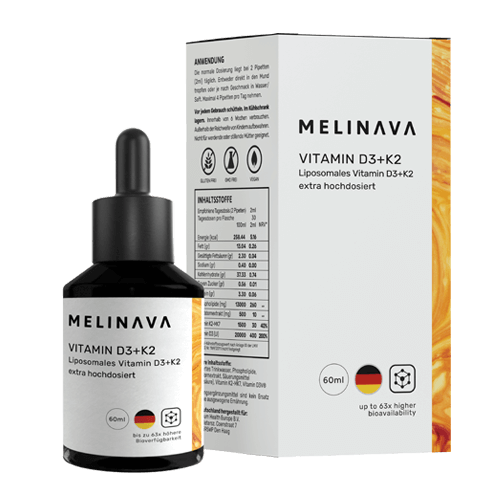
MELINAVA Vitamin D3 + K2
by MELINAVA
Pros
- Ideal dose: 25 µg vitamin D3 (1,000 IU)
- Combined with 75 µg vitamin K2
- High bioavailability thanks to liposomes (13 times higher)
- Vitamin D in the best available form
- Vitamin K2 in the highest-quality form (MK-7 all-trans)
- Vegan
- Made in Europe
- Free from soya, gluten and lactose
- No added preservatives
- No added allergens
- GMO-free
Cons
- Only available online
- Often sold out
Verdict
Melinava Vitamin D3 + K2 is high-strength, with 1,000 international units (IU) of vitamin D3 per daily dose. With added K2, you get an optimal supply of both active ingredients.
Because the active ingredient is encapsulated in liposomes, much lower doses are needed than with conventional supplements.
The vitamin D3 in Melinava is obtained from 100% GMO-free, sustainably sourced algae and is completely free from animal-derived ingredients.
Melinava's formulation uses only the active form of vitamin D. The vitamin K2 also comes in the highest-quality form available, MK-7 all-trans.
Thanks to modern liposome technology, the bioavailability of Melinava is up to 13 times higher. The liposomal coating improves tolerability, and the active ingredient goes directly into the bloodstream.
User satisfaction and the many positive customer reviews of Melinava Vitamin D3 and K2 speak for themselves. In our test, Melinava takes first place (as of January 2026).
People have already used Melinava with very good results for symptoms such as lack of energy, poor concentration and depressed mood, as well as for a weakened immune system.
There are no known side effects so far. Many customers say they tolerate it very well and report a rapid rise in their vitamin D levels.
The manufacturer takes tolerability very seriously, which is why the product is completely free from unwanted additives.
You can find more information on the manufacturer's website.*
A month's supply of Melinava costs 509 kr
(discounts are available when you buy two or three packs, as of January 2026).
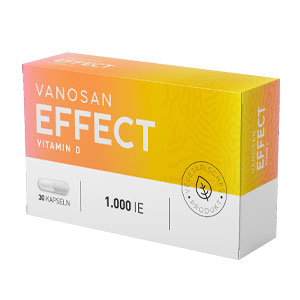
Vanosan Vitamin D3
by VANOSAN
Pros
- Laboratory-tested
- Good value for money
- Vegetarian
- Made in Germany
- No added preservatives
- No added allergens
Cons
- Not highly bioavailable
- Not vegan
Verdict
Vitamin D3 from Vanosan provides a good dose, with 1,000 IU (international units) per daily dose. However, the form it comes in limits how well your body can absorb it.
Vanosan Vitamin D3 contains vitamin D3 derived from lanolin (wool wax), so it is not suitable for vegans.
Users are mostly positive about this vitamin D3. It is well tolerated and relieves symptoms such as tiredness and low energy.
It is made in Europe, and orders are usually dispatched within 1–3 working days.
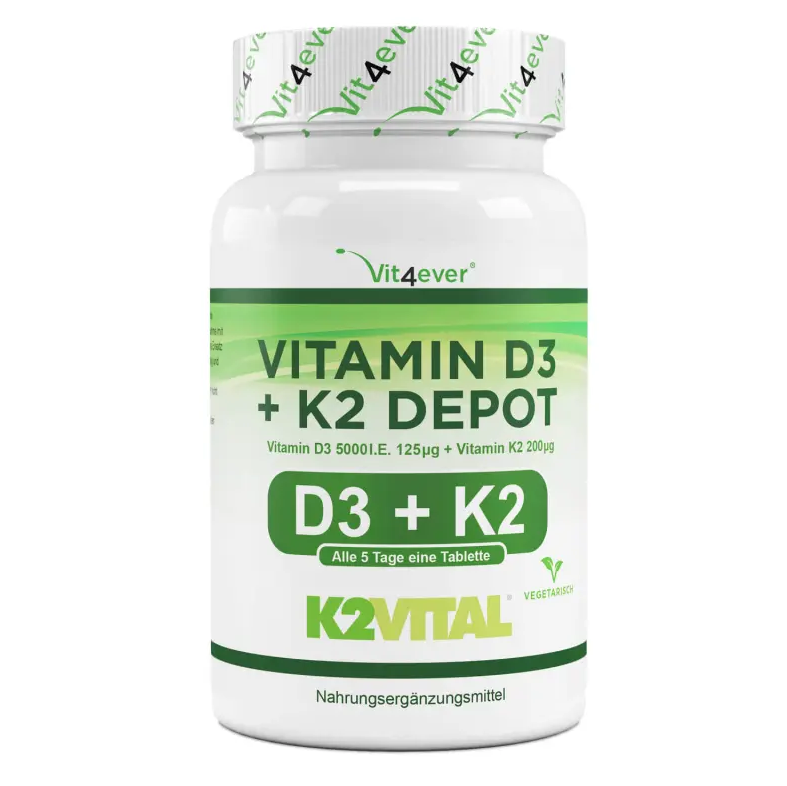
Vitamin D3 + K2 Depot
by ACTINUM
Pros
- High-strength
- Vitamin K2 in the high-quality MK-7 form (K2VITAL Kappa)
- Laboratory-tested
- Good value for money
- Vegetarian
- Made in the EU
- Gastro-resistant capsule
- No added preservatives
- 1 capsule every 5 days
Cons
- Not vegan
- Contains fillers and anti-caking agents
Verdict
Vitamin D3 + K2 Depot from Actinum contains 5,000 IU (international units) per capsule, which works out at a daily dose of 1,000 IU, making it high-strength. With added K2, you get an optimal supply of both active ingredients.
The capsules are comparatively small, which makes them easier to take.
Users are mostly positive about Vitamin D3 + K2 Depot. It is well tolerated and relieves symptoms such as lack of energy and fatigue. However, users with chronic symptoms often find the effect unsatisfactory. Some customers criticise the quality and size of the container.
It is made in Europe, and orders are usually dispatched within 1–3 working days.

Vitamin D plays a crucial role in keeping skin cells healthy. It helps your skin cope better with environmental stress and regenerate faster.
Vitamin D3 supplements: the key to healthy, radiant skin
Too much sun can lead to a range of health problems, ranging from dry skin and premature skin ageing (more wrinkles) to skin cancer. A vitamin D supplement ensures you get the amount you need while completely ruling out the risk of skin problems or diseases caused by sun exposure.
A 2019 study showed that daily vitamin D supplements led to an improvement in skin condition in people with sun sensitivity and skin problems such as acne and eczema. Getting enough vitamin D may also help keep your skin better hydrated and less wrinkled.

Natural immune support
Research in recent years has shown that vitamin D plays a key role in the immune system. Without vitamin D, certain immune cells can't be produced and important defence reactions can't take place. For a strong immune system, a sufficient vitamin D level is essential.
An optimal intake of vitamin D can improve immune function by stimulating the production of antibodies and T cells, which supports your body's defences against infections and inflammation. There are signs that vitamin D deficiency may increase the risk of infections, especially respiratory infections such as flu and pneumonia.
Forms of vitamin K2
There are several forms of vitamin K2, but the two most important are MK-4 (menaquinone-4) and MK-7 (menaquinone-7). MK-4 is found in animal products such as meat and eggs, and your body also produces it. MK-7, on the other hand, is made by bacteria in fermented foods such as natto, sauerkraut and cheese. MK-7 is known for its longer half-life in the body, which means it stays in the bloodstream longer and therefore has a stronger effect. MK-7 is also better at depositing calcium in the bones, which helps to strengthen your bones. Food supplements contain either MK-4 or MK-7, or a combination of both forms.
Vegan vitamin D3
Most vitamin D3 supplements on the market are not vegan. The D3 they contain is made from lanolin (wool wax or wool grease, a secretion from the sebaceous glands of sheep) or fish oil. These days, however, some manufacturers avoid animal sources completely and offer purely plant-based products. Vegan vitamin D3 is obtained from lichens (fungi and algae). The manufacturing process is more complex, so vegan products are often a little more expensive.
Vitamin D3 + K2 is a versatile pair, with roles in your bones, immune system and heart.
Take a look at our comparison and find the product that suits your needs.
See the vitamin D products we tested
* We may earn a commission from some of the companies featured. This is how we keep our comparisons free to read.
Some of these companies are our commercial partners.
Sources
1. Annweiler, C., Hanotte, B., de l'Eprevier, C. G., Sabatier, J. M., Lafaie, L., & Célarier, T. (2020). Vitamin D and survival in COVID-19 patients: A quasi-experimental study. The Journal of steroid biochemistry and molecular biology, 204, 105771.
2. Amrein, K., Scherkl, M., Hoffmann, M. et al. Vitamin D deficiency 2.0: an update on the current status worldwide. Eur J Clin Nutr 74, 1498–1513 (2020). https://doi.org/10.1038/s41430-020-0558-y
3. Norman, A. W. (2008). From vitamin D to hormone D: fundamentals of the vitamin D endocrine system essential for good health. The American Journal of Clinical Nutrition, 88(2), 491S-499S.
4. Grant, W. B., Al Anouti, F., & Moukayed, M. (2020). Targeted 25-hydroxyvitamin D concentration measurements and vitamin D3 supplementation can have important patient and public health benefits. European Journal of Clinical Nutrition, 74(3), 366-376.
5. Beulens, J. W., Booth, S. L., van den Heuvel, E. G., Stoecklin, E., Baka, A., & Vermeer, C. (2013). The role of menaquinones (vitamin K2) in human health. British Journal of Nutrition, 110(8), 1357-1368.
6. Charoenngam, N., & Holick, M. F. (2020). Immunologic effects of vitamin D on human health and disease. Nutrients, 12(7), 2097.
7. Ao, T., Kikuta, J., & Ishii, M. (2021). The effects of vitamin D on immune system and inflammatory diseases. Biomolecules, 11(11), 1624.
8. Carlberg, C., & Muñoz, A. (2022, February). An update on vitamin D signaling and cancer. In Seminars in cancer biology (Vol. 79, pp. 217-230). Academic Press.
9. Harrison, S. R., Li, D., Jeffery, L. E., Raza, K., & Hewison, M. (2020). Vitamin D, autoimmune disease and rheumatoid arthritis. Calcified tissue international, 106, 58-75.
10. https://www.sciencedirect.com/science/article/pii/S187595721830651X