
Guide
The best vitamin B12 supplements compared (2026)
Last updated: 30 July 2026

Written by
Health Tested Editorial Team
Vitamin B12 is an essential vitamin that plays a crucial role in many of the body's functions. Although it's widespread in nature, many people are deficient in this important vitamin.
In fact, the World Health Organization estimates that around 1.5 billion people worldwide have a deficiency. This affects health and wellbeing, particularly the immune system, the nervous system and the brain. As well as playing an important role in energy metabolism, vitamin B12 protects the cardiovascular system and is indispensable for the formation of red blood cells.
It's one of the most versatile vitamins, yet also one that people most often don't get enough of.
But which vitamin B12 is right for you?

There are countless vitamin B12 supplements on the market, but not all of them are effective.
The problem with vitamin B12
Vitamins are essential nutrients your body needs to work properly. There are fat-soluble vitamins, such as vitamins A, D, E and K, and water-soluble vitamins, such as vitamin C and the B vitamins.
What makes vitamin B12 special is that the human body can't produce it itself, so you need a regular supply from your diet. Most people get it from animal products such as meat, fish, eggs and dairy. This water-soluble nutrient is the only vitamin found almost exclusively in animal foods.
However, vitamin B12 is extremely sensitive to heat and is destroyed at temperatures above 80°C.
That's why eating animal foods alone can't ensure you get enough vitamin B12.
A vitamin B12 deficiency can have serious consequences, particularly for the immune system, the nervous system and the cardiovascular system.
What your body needs vitamin B12 for
Your body relies on vitamin B12 for a surprising number of jobs. Here's why this nutrient matters so much:
- forming red blood cells
- forming DNA and RNA (and so taking part in cell growth and cell division)
- getting folic acid into cells
- breaking down various fatty acids
- keeping the nervous system working
- forming the sheath around nerve fibres
- supporting the body's natural detoxification processes
- supporting energy metabolism
Causes of vitamin B12 deficiency
A vitamin B12 deficiency can have various causes:
- chronic inflammation of the stomach or gut
- taking certain medicines (e.g. antibiotics, antacids and other acid-reducing drugs)
- drinking alcohol regularly
- stress
- poor diet
- an unhealthy lifestyle
- a vegan diet
- harmful environmental factors
- ageing (lower levels of intrinsic factor)
- certain underlying conditions (e.g. Crohn's disease)
How gut health affects vitamin B12
'A healthy gut is the root of all health.' (Hippocrates)
One of the main reasons for a vitamin B12 deficiency is poor gut health and the absorption problems that result from it. Many negative influences, such as taking certain medicines (e.g. antibiotics), an unhealthy diet (especially sugar and fat), alcohol, smoking, stress, lack of sleep and illness, can seriously harm the gut flora.
Once the gut flora is out of balance, a downward spiral can quickly develop, because the ability to absorb nutrients declines as gut health gets worse. Nutrients such as vitamin B12 are then not absorbed well enough in the gut, so less reaches the bloodstream.
This in turn harms gut health and at the same time leads to a nutrient deficiency. As its resilience weakens, the gut flora becomes vulnerable to overgrowth by harmful bacteria or fungi.
That's why vitamin B12 supplements are often recommended together with probiotics, to ensure the vitamin is absorbed.Signs of vitamin B12 deficiency
Vitamin B12 deficiency is widespread. In Germany, one in ten people is affected, rising to around one in four among the over-65s.
The following symptoms can occur if you're deficient:
- tiredness
- weakness and confusion
- anaemia
- headaches
- digestive problems
- hair loss
- nerve problems
- muscle weakness
- tingling in the arms and legs
- sensory disturbances and, in severe cases, paralysis
- a burning tongue
Psychological symptoms can also occur:
- attention problems
- low mood
- mood swings
- nervousness and irritability
- neurological disorders
- poor concentration and memory
Absorbing vitamin B12: intrinsic factor
There are two ways to absorb vitamin B12: an active one and a passive one. In the active route, which is supported by intrinsic factor, your body has to use energy to absorb the vitamin. Intrinsic factor is a special transport protein that binds vitamin B12 in the gut and carries it to specialised receptors in the gut lining. This is an active process, because energy is needed to bind vitamin B12 to intrinsic factor and then bring it to the receptors. The active route is very efficient, but there are only a limited number of receptors that can take up vitamin B12.
In the passive route, by contrast, your body doesn't have to use any energy to absorb vitamin B12. It's simply absorbed by diffusion. However, the amount absorbed this way is very limited and comes to only around 1% per dose. That's why you need to take high doses of vitamin B12 to absorb enough of it, and why many vitamin B12 supplements contain such high doses (around 500–1,000 µg a day). So the passive route is less efficient than the active one, but it doesn't need any energy.
Liposomes are the exception here. Thanks to the liposomal coating, absorption of the liquid B12 formulation is not limited, and intrinsic factor is bypassed.
Note: not all liquid products are automatically liposomal.
Forms of vitamin B12
There are various forms of vitamin B12 that can be found in food supplements. These forms affect how well your body can absorb and use the vitamin. Here are the best-known ones:
Methylcobalamin: this form is natural and easy for your body to absorb (highest bioavailability). It's already a biologically active form, which means your body doesn't have to convert it into an active form. It can be particularly good at supporting the nervous system and regulating homocysteine levels.
Adenosylcobalamin: this form also occurs naturally and is another biologically active form of vitamin B12. It works well together with methylcobalamin to protect the nervous system and is involved in energy production.
Cyanocobalamin: this is the form most often used in vitamin B12 supplements. It's a synthetic form that is converted in the body into adenosylcobalamin or methylcobalamin. Although it isn't natural in origin, it's relatively stable and cheap to produce.
Benefits of taking vitamin B12
Taking the right vitamin B12 supplement can achieve the following goals:
- less tiredness and exhaustion
- better concentration
- a stronger immune system and better metabolism and nervous system function
- better eyesight

There are several factors to consider when choosing the right vitamin B12 supplement.
What to avoid when buying vitamin B12
When you take vitamin B12 supplements, make sure they don't contain additives that could cancel out the very benefits you're taking them for. Only use products of the highest quality: it's your health at stake.
When you're looking for your vitamin B12 supplement, make sure you avoid the following:
- a low dosage
- products without a bioactive form of B12
- gelatine capsule shells, binders and anti-caking agents
- any allergens you react to, such as soya, gluten and lactose
- capsules that aren't gastro-resistant
- supplements at suspiciously low prices
- products that advertise extremely high doses
Which types of vitamin B12 supplement are available?
Vitamin B12 supplements come in various forms, each with its own advantages and drawbacks:
- capsules
- drops
- liposomal form
Tablets are among the most controversial forms. They often contain numerous additives that can have negative effects.
Capsules
Pros
Easy to swallow
Practical when travelling
Easy to dose (consistent active ingredient content)
No unpleasant taste or smell
Cons
Stomach acid can affect absorption of the active ingredient
Digestion can partly break down the active ingredient
The capsule shell may contain gelatine
Unsuitable if you have difficulty swallowing
A high dose may mean taking several capsules
Drops
Pros
Easy to dose
Fast absorption of the active ingredient (via the mucous membranes)
Good for people with difficulty swallowing or stomach problems
Versatile: can be mixed into drinks or food
Cons
The drops can taste unpleasant
Exact dosing can be difficult, as the number of drops varies
The liquid can leak or spill
Shorter shelf life than capsules
Liposomal form
Pros
Higher bioavailability of the active ingredient
Better absorption by bypassing stomach acid
A lower dose is needed for the same effect
Can mask the taste of the active ingredient
No additives
Cons
May cost more because manufacturing is more complex
Availability and choice may be limited
Making liposomes can be difficult and requires specialised technology
Because they measure just nanometres across and are rich in fats, liposomes protect the vitamin B12 inside them from being broken down by enzymes, such as those in saliva and the stomach. They deliver vitamin B12 directly into the bloodstream, which significantly improves absorption of the vitamin.
Vitamin B12 in true liposomal form
Liposomes are tiny (lipid) vesicles made of the same material as human cell membranes. In liposome technology, nutrients (such as vitamin B12) are encapsulated, so your body doesn't see the enclosed active ingredient as a 'foreign body'. This means your body can absorb the active ingredients directly into the bloodstream with nothing lost along the way.
The liposomal coating is an innovative solution that lets your body absorb and make the best use of large amounts of the active ingredients.
Because the vitamins are directly available, much lower doses are needed than with conventional supplements. Studies have found that liposomal vitamin B12 can be absorbed around 13 times better by the body.
Note: not all supplements are automatically liposomal.

A simple model of a liposome, with a fatty layer on the outside and a watery chamber inside. Liposomes are an innovative technology for releasing active ingredients precisely and efficiently. That's why they've earned a firm place in medicine and cosmetics and are known for their wide range of uses.
Top 3: the best vitamin B12 supplements on the market
Finding the right vitamin B12 isn't easy.
That's why we assess vitamin B12 supplements against the following six criteria:
How is the vitamin B12 supplement formulated?
Are there any study or test results?
How high is the dose of the vitamins? (neither too high nor too low)
Does the product contain any allergens?
How good is the value for money?
Is there anything special about the formulation or production?
The most important factor: how is the vitamin B12 supplement formulated?
The most important factors when choosing a vitamin B12 supplement are the bioavailability, the dosage, the type of vitamin B12 formulation and the quality of the ingredients. This means the supplement should contain a form of vitamin B12 that your body can absorb effectively. The most commonly used forms are methylcobalamin and cyanocobalamin. Methylcobalamin has the advantage that your body can absorb it more easily and convert it into active vitamin B12. Cyanocobalamin, on the other hand, is more stable and has a longer shelf life. However, your body first has to convert it into methylcobalamin before it can be used. Cyanocobalamin is much cheaper than methylcobalamin and is found in most supplements.
That's why methylcobalamin is the better-quality form to look for in an effective vitamin B12 supplement.
The quality of the ingredients is another important factor, as poor-quality ingredients can reduce the supplement's effectiveness. It's worth looking for supplements that come from high-quality, natural sources and are free from additives.
product review
TESTED
our quality criteria
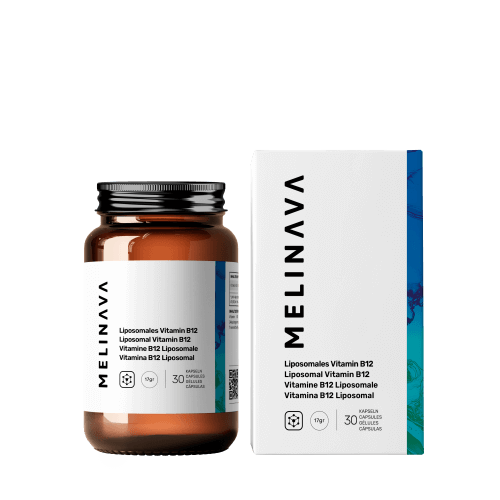
MELINAVA Vitamin B12
by MELINAVA
Pros
- Liposome technology
- High bioavailability thanks to liposomes (64 times higher)
- Contains bioactive vitamin B12 as methylcobalamin
- High-quality B12 sourced from the EU
- Stomach acid does not destroy the active ingredient (thanks to the liposomal coating)
- Also contains sea buckthorn extract (vitamin C)
- Vegan
- Made in France
- Free from soya, gluten and lactose
- No added preservatives
- No added allergens
- GMO-free
Cons
- Only available online
- Often sold out
Verdict
Melinava Liposomal Vitamin B12 is high-strength, with 500 µg per daily dose.*
*Because the active ingredient is encapsulated in liposomes, much lower doses are needed than with conventional supplements.
The vitamin B12 it contains is in the active form, methylcobalamin. This form stands out for its particularly high bioavailability.
Melinava is one of the strongest over-the-counter vitamin B12 products on the German market.
You can also open the capsules and stir the contents into a drink.
The formulation and dosage are matched to each other to prevent and relieve a wide range of symptoms.
The innovative liposome technology ensures the vitamin is absorbed optimally in the gut and passes from there into the bloodstream.
This process increases the bioavailability of Melinava by up to 64 times. Thanks to the liposomal coating, absorption of the liquid B12 formulation is not limited, and intrinsic factor is bypassed.
User satisfaction and the many positive customer reviews of Melinava Vitamin B12 testify to the product's success.
Melinava has already been used with very good results for symptoms such as lack of energy, low mood and muscle weakness, as well as poor concentration and memory.
Melinava takes first place in our test (as of January 2026). The manufacturer takes tolerability very seriously, which is why the product is completely free from unwanted additives.
You can find more information on the manufacturer's website.* A month's supply of Melinava costs 509 kr (discounts when you buy 2 or 3 packs, as of January 2026).
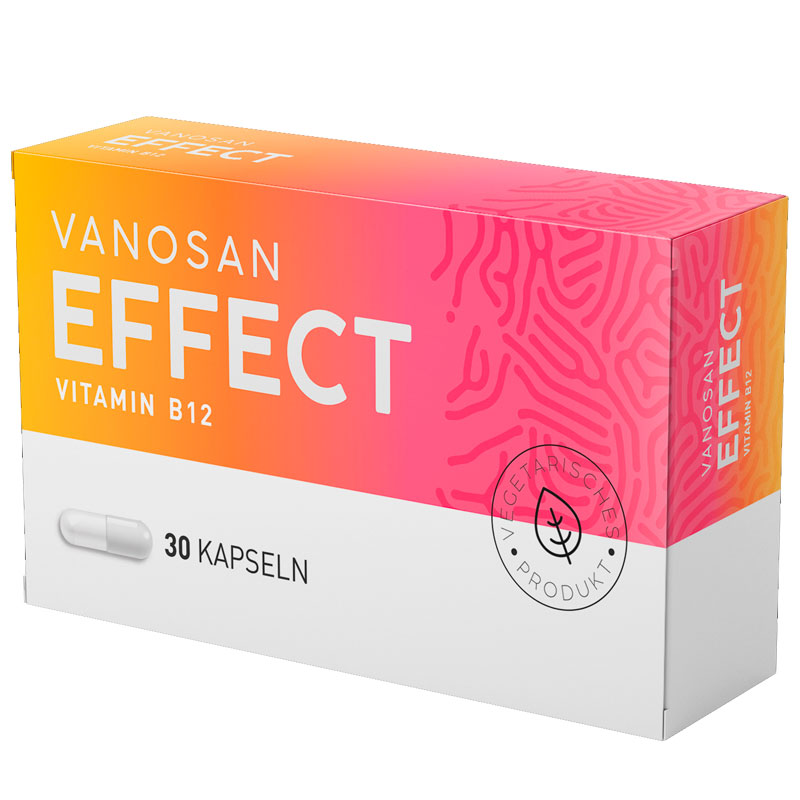
Vanosan B12
by VANOSAN
Pros
- Suitable for acute B12 deficiency
- B12 as cyanocobalamin
- Vegetarian
- Made in the EU
- No added preservatives
- No added allergens
- GMO-free
- Also available in pharmacies
Cons
- Limited absorption
- Not vegan
- Not lactose-free
- Does not contain bioactive vitamin B12
Verdict
Vanosan B12 is a good strength, with 1,000 µg per daily dose.
Vanosan B12 tablets contain cyanocobalamin, the inactive form of vitamin B12. The body first has to convert cyanocobalamin into adenosylcobalamin or methylcobalamin.
Users are mostly positive about Vanosan B12. It is well tolerated and helps build up the body's B12 stores. For many users, taking it over a longer period reduces symptoms such as poor concentration and memory, excessive tiredness and exhaustion.
Some customers criticise the additives it contains (titanium dioxide in particular). Vanosan B12 contains lactose and is therefore not suitable for vegans.
Vanosan B12 is made in the EU and is available from Amazon and various online pharmacies. Delivery usually takes 2–3 working days.
Vitasprint B12 drinkable vials
by GSK
Pros
- High-strength
- Suitable for acute B12 deficiency
- B12 as cyanocobalamin
- Vegan
- Made in the EU
- No added allergens
- GMO-free
- Also available in pharmacies
Cons
- Does not contain bioactive vitamin B12
- Poor value for money
Verdict
Vitasprint B12 drinkable vials from GSK are high-strength, with 500 µg per daily dose.
Vitasprint contains cyanocobalamin, the inactive form of vitamin B12. The body first has to convert cyanocobalamin into adenosylcobalamin or methylcobalamin.
Vitasprint is mainly recommended as a longer course to replenish the body's B12 stores.
Users are mostly positive about Vitasprint B12 drinkable vials. They are well tolerated and help with tiredness, lack of energy and poor concentration. Some customers criticise the vials for breaking easily. Customer opinions on the (raspberry) flavour are quite mixed.
Delivery with Amazon Prime is free and usually takes 1–2 working days. Vitasprint is also available in pharmacies.

Getting enough vitamin B12 is important for strengthening the immune system and reducing the risk of infections and inflammation.
Vitamin B12 and the immune system: how it strengthens your defences
Vitamin B12 plays an important role in a healthy immune system. It contributes to the formation of white blood cells, which are responsible for fighting off pathogens in the body. A vitamin B12 deficiency can also lead to a weakened immune system, because the vitamin is needed for cell division and DNA synthesis. Getting enough vitamin B12 can therefore help strengthen the immune system and reduce the risk of infections and illness. Older people, vegetarians and vegans, and people with conditions such as Crohn's disease or coeliac disease should take particular care to make sure they get enough vitamin B12 to support the immune system.

Vitamin B12 also has a major effect on brain function
Vitamin B12 plays an important role in how the nervous system works and can improve brain function. Getting enough vitamin B12 can support memory and cognitive function and reduce the risk of neurodegenerative diseases such as Alzheimer's and dementia. A study from 2018 found that older adults with a higher vitamin B12 intake had better episodic memory than those with lower vitamin B12 levels.¹ It has also been shown that vitamin B12 can improve concentration and attention. Another study, from 2016, found that people with low vitamin B12 levels may be at higher risk of depression and mood disorders,² which suggests that vitamin B12 also influences mood regulation.

Medical tests are needed to establish a deficiency with certainty.
Diagnosing a vitamin B12 deficiency
Blood test
The most common method is a blood test, although the effects of a deficiency don't show up straight away. Vitamin B12 is stored mainly in the liver, and deficiency anaemia usually only develops after 2–5 years. That's why a blood test should measure not only vitamin B12 but also holotranscobalamin (holo-TC), serum homocysteine and methylmalonic acid levels. If vitamin B12 and/or holo-TC levels are low, homocysteine or MMA (methylmalonic acid) levels should be checked to see whether they are raised.
Urine test
The MMA test, which checks a urine sample for methylmalonic acid, is cheaper and faster than a blood test. A raised level of this acid is a reliable sign of a vitamin B12 deficiency. The MMA test can detect a shortfall at a very early stage.
* We may earn a commission from some of the companies featured. This is how we keep our comparisons free to read.
Some of these companies are our commercial partners.
Sources
- Syed, E. U., Wasay, M., & Awan, S. (2013). Vitamin B12 supplementation in treating major depressive disorder: a randomized controlled trial. The open neurology journal, 7, 44–48. https://doi.org/10.2174/1874205X01307010044
- Köbe, T., Witte, A. V., Schnelle, A., Grittner, U., Tesky, V. A., Pantel, J., Schuchardt, J. P., Hahn, A., Bohlken, J., Rujescu, D., & Flöel, A. (2016). Vitamin B-12 concentration, memory performance, and hippocampal structure in patients with mild cognitive impairment. The American journal of clinical nutrition, 103(4), 1045–1054. https://doi.org/10.3945/ajcn.115.116970
- Leishear, K., Ferrucci, L., Lauretani, F., Boudreau, R. M., Studenski, S. A., Rosano, C., Abbate, R., Gori, A. M., Corsi, A. M., Di Iorio, A., Guralnik, J. M., Bandinelli, S., Newman, A. B., & Strotmeyer, E. S. (2012). Vitamin B12 and homocysteine levels and 6-year change in peripheral nerve function and neurological signs. The journals of gerontology. Series A, Biological sciences and medical sciences, 67(5), 537–543. https://doi.org/10.1093/gerona/glr202
- Koury, M. J., & Ponka, P. (2004). New insights into erythropoiesis: the roles of folate, vitamin B12, and iron. Annual review of nutrition, 24, 105–131. https://doi.org/10.1146/annurev.nutr.24.012003.132306
- Paul, C., & Brady, D. M. (2017). Comparative Bioavailability and Utilization of Particular Forms of B12 Supplements With Potential to Mitigate B12-related Genetic Polymorphisms. Integrative medicine (Encinitas, Calif.), 16(1), 42–49.
- Watanabe, F. (2007). Vitamin B12 sources and bioavailability. Experimental Biology and Medicine, 232(10), 1266-1274. https://doi.org/10.3181/0703-MR-67
- Clarke, R., Smith, A. D., Jobst, K. A., Refsum, H., Sutton, L., & Ueland, P. M. (1998). Folate, vitamin B12, and serum total homocysteine levels in confirmed Alzheimer disease. Archives of Neurology, 55(11), 1449-1455. https://doi.org/10.1001/archneur.55.11.1449