
Guide
Vitamin A: the best products compared (2026)
Last updated: 29 July 2026

Written by
Health Tested Editorial Team
Vitamin A is one of those vitamins you rarely think about, until you realise how much your body depends on it.
Metabolism, the look of your skin, eyesight: vitamin A is involved in countless processes, and when you're short of it, your quality of life can suffer considerably.¹
Yet this vitamin is often underestimated. Many people only get it irregularly from their diet and as a result slip into a shortfall faster than they might think.²
In our big 2026 vitamin A review, you'll find out why it's worth looking closely at how much vitamin A you get, which signs may point to a deficiency and which products in our comparison really stand out.

There are countless vitamin A supplements on the market, but not all of them are effective.
Vitamin A: the underrated all-rounder
Vitamin A is a true 'all-rounder' among vitamins. It supports the renewal of skin and mucous membranes, which strengthens the body's outer protective barriers. It supports the immune system and can make a noticeable difference, especially in the colder months or at times of increased stress.
On top of that, vitamin A is needed for the growth and formation of new cells and tissues. Its plant precursor, beta-carotene, also acts as an antioxidant and helps protect cells from premature ageing and oxidative stress.
Two areas deserve special mention, because vitamin A is indispensable for both: skin health and eyesight.
Indispensable for healthy eyes and good vision
Vitamin A is often called 'the eye vitamin' because it's a key building block of the light-sensitive visual purple (rhodopsin) in the retina. This protein is what lets you see at dusk or in the dark.
Without enough vitamin A, this process doesn't work properly. Even a mild shortfall can impair your night vision.
A more severe deficiency can lead to eye fatigue, night blindness or damage to the photoreceptor cells.Vitamin A for acne: why it helps
Vitamin A is an important nutrient for skin health. It regulates sebum production, supports cell renewal and has an anti-inflammatory effect. These properties make it a reliable active ingredient in the treatment of acne, especially when other products haven't helped enough.⁵
What do studies say?
- Several studies used high doses of vitamin A (100,000–300,000 IU a day) for acne.
- The results show that after 2–3 months, many participants had much clearer skin and their acne had improved considerably.⁶

Vitamin A therapy can help with blemishes and acne. Its anti-inflammatory effect can reduce visible breakouts.
The key benefits of vitamin A
Vitamin A contributes to the following areas:
- your eyes and eyesight, especially at dusk and in the dark
- a strong immune system
- beautiful skin
- mucous membranes
- cell protection and cell division
- wound healing
- reproductive function in men and women
- bones
- development during periods of growth
How much vitamin A do you need?
How much vitamin A you need depends on your age, sex and personal circumstances. The German Nutrition Society (DGE) recommends the following daily intake for adults:³
- Men: around 1,000 µg retinol equivalents (RAE)
- Women: around 800 µg RAE
- Pregnant women: 1,100–1,500 µg RAE (depending on the stage of pregnancy)
- Breastfeeding women: 1,500 µg RAE
These amounts correspond to roughly 2,600–5,000 international units (IU), depending on the form of vitamin A.
How to spot a vitamin A deficiency early
A vitamin A deficiency often develops gradually, so look out for these symptoms:
- poorer eyesight, especially in the dark ('night blindness')⁸
- frequent infections
- dry, flaky or inflamed skin
- dry eyes
- dry mouth
- delayed growth in children and teenagers⁹
- brittle hair or increased hair loss
- general exhaustion
- a feeling of weakness
Vitamin A supplements: what matters
The many vitamin A supplements on sale today can differ considerably.
You can choose between standard retinol capsules, beta-carotene products and liposomal versions.
These quality markers matter most:
- the form of vitamin A used
- the right amount of active ingredient
- a form that is easily absorbed
- a formula that is as pure as possible, without unnecessary additives
- sensible combinations with supporting nutrients
To help you choose, we've summarised the most important criteria. Below, you'll see which products stood out in 2026.

There are several factors to consider when choosing the right vitamin A supplement.
Retinyl palmitate: the most stable form of vitamin A
Vitamin A is vital for your skin, eyes and immune system, but not all forms work in the same way or are equally safe. Supplements often contain retinol and beta-carotene, but there's one form that stands out even more: retinyl palmitate.
Retinol: the active form of vitamin A, which works effectively against skin blemishes, promotes cell renewal and strengthens the mucous membranes. At too high a dose, though, it can be harmful to your health. Even single doses above 300,000 IU can trigger symptoms such as nausea, headaches and skin irritation.¹⁰
Beta-carotene: the plant precursor of vitamin A, and much safer. Your body only converts it into retinol when it's needed, so an overdose is very unlikely. However, this conversion varies greatly from person to person and is poor in some people.¹¹
Retinyl palmitate: the most stable and safest form of vitamin A. Your body converts it into retinol as needed: gently, in a controlled way and without sudden spikes in blood levels.
In short: combining good bioavailability with a high level of safety, retinyl palmitate is considered the most balanced form of vitamin A.What to avoid when buying vitamin A
If you decide to take a supplement, steer clear of the following:
- low bioavailability
- products with too low a dose
- capsules containing gelatine
- fillers and anti-caking agents
- allergens (lactose, gluten, soya)
- unnecessary additives
- sugar, alcohol or flavourings
- artificial colourings
- inflated prices
Dosage forms: how can you take vitamin A?
Your body can't produce vitamin A itself, so it has to come from your diet or from a food supplement.
These forms are commonly available:
- drops
- oil (as retinol)
- capsules
- tablets
- powder (as beta-carotene)
- fortified foods
- liposomal supplements
The most common forms on the market are capsules, drops and liposomal supplements, so we look at the differences between them in more detail below.
Capsules
Pros
Easy to swallow
Convenient when travelling and on the go
Easy to dose (each capsule contains the same amount)
No unpleasant taste or smell
Can be combined with other active ingredients
Cons
Stomach acid can affect absorption of the active ingredient
Digestion can partly break down the active ingredient
The bioavailability of the active ingredient can vary
The capsule shell may contain gelatine
Often contain additives
Unsuitable for people with swallowing difficulties
With a low-dose product, you may need several capsules
Drops
Pros
Easy to dose
Fast absorption of the active ingredient (via the mucous membranes)
Good for people with swallowing difficulties or stomach problems
Versatile: can be mixed into drinks or food
Cons
The drops can taste unpleasant
Exact dosing can be difficult, as the number of drops varies
The liquid can drip or spill
Short shelf life
Liposomal form
Pros
Higher bioavailability of the active ingredient
Better absorption by bypassing stomach acid
Lower dose needed for the same effect (usually just one capsule)
Can mask the taste of the active ingredient
No additives
Cons
May cost more because manufacturing is more complex
Availability and choice may be limited
Producing liposomes can be difficult and requires specialised technology
Less choice, as not all manufacturers use the process
Liposomal vitamin A: optimal absorption and tolerability
Many conventional vitamin A products have a weak spot: your body can only absorb part of the vitamin A they contain.
This is exactly where liposomal products come in: the vitamin A is embedded in tiny fat bubbles called liposomes.
This technology makes it easier to transport the nutrients into the body, which improves their absorption.
Liposomes can pass through cell membranes more easily, so the nutrients can be put to better use. At the same time, they protect the contents from digestion, so they remain fully effective.
The result: more vitamin A reaches the bloodstream and the target cells directly in its active form, where it can do its job for your skin, eyes and immune system most effectively.
This means a lower dose can have a comparable or even stronger effect.Gentle on the stomach and gut
Liposomal vitamin A isn't just more effective, it's also particularly well tolerated. Liposomes stop the nutrients from coming into direct contact with the sensitive stomach lining, so they don't irritate the digestive tract. This lowers the risk of side effects such as an upset stomach.
These properties make liposomal supplements ideal for people with a sensitive stomach or anyone who reacts badly to conventional supplements.

A simple model of a liposome. A liposome is like a tiny bubble with a fatty layer on the outside and a watery chamber inside. This structure is what makes liposomes so effective, because it lets them transport and release active ingredients selectively. Thanks to this innovative technology, liposomes have become increasingly important in medicine and cosmetics. They allow active ingredients to be absorbed effectively, protect them from being broken down and have a wide range of uses.
Top 3: the best vitamin A products of 2026
There are countless vitamin A products on the market today. We analysed them against a range of factors to bring you the best:
What is the supplement made of?

Are there studies or scientific papers?

How high is the dosage of each nutrient?
Does the product contain allergens?

How good is the value for money?

Are there any special features in the composition or manufacturing?
What to look for when choosing a vitamin A product
1. Form of vitamin A
- Retinyl palmitate is considered particularly stable and well tolerated, and your body converts it into active retinol in a controlled way as needed.
- Retinol works directly, but can be risky at too high a dose.
- Beta-carotene (the plant precursor) is safe, but how well it's converted into retinol can vary widely from person to person.
2. Absorption and bioavailability
- Liposomal and other modern formulations can significantly improve absorption in the gut.
- Vitamin A is fat-soluble, so how well it's absorbed depends on how much fat you eat and on your digestion.
3. Safety
- In pregnancy in particular, retinol should only be taken under medical supervision.
- Supplements usually contain safe amounts that are well below critical thresholds.
4. Quality and manufacturer
- High-quality supplements use tested forms of the active ingredient and robust packaging that protects the contents from light, oxygen and heat.
product review
TESTED
our quality criteria
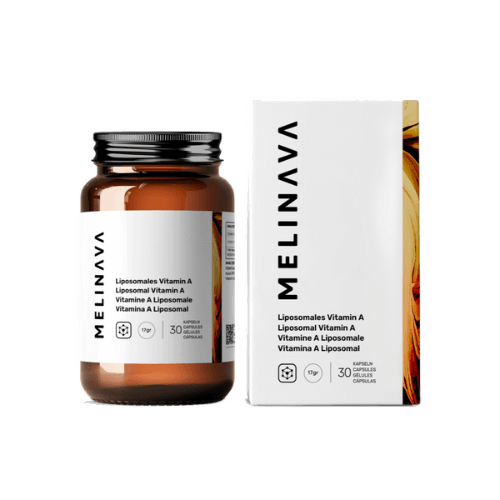
MELINAVA Liposomal Vitamin A
by MELINAVA
Pros
- High daily dose of 800 µg of vitamin A
- In the stable retinyl palmitate form
- Up to 64 times better absorption thanks to the liposomal formulation
- Ideal dose to cover your daily requirement
- Protection against heartburn thanks to the liposomal coating
- Longer-lasting effect
- Better tolerability
- Suitable for people with a sensitive stomach
- Free from soya, gluten and lactose
- Gelatine-free capsule
- Made in Europe (France)
- Supplied in a high-quality glass bottle you can reuse at home
Cons
- Only available online
- Often sold out
- Only available as capsules
Verdict
Melinava Liposomal Vitamin A offers retinyl palmitate, a particularly effective form that the body absorbs very well. Each capsule provides 800 µg of vitamin A in liposomal form. That is a lower dose than in other products on the market, but thanks to its liposomal formulation, Melinava achieves better results.
Vitamin A plays a central role in eyesight and supports the normal adaptation of the eyes to darkness. It also contributes to the maintenance of healthy skin, mucous membranes and hair and strengthens the body's natural defences, helping to protect it from outside threats.
Thanks to the liposomal coating, your body makes particularly efficient use of the vitamin, and the capsules are gentler on the stomach too.
MELINAVA manufactures to the highest quality and safety standards and deliberately leaves out unnecessary additives to ensure a pure, high-quality product.
Many users say their eyes feel less tired and praise how well tolerated the capsules are.
Melinava Liposomal Vitamin A also stands out for being easy to take: one capsule a day, ideally with a meal, is all it takes to cover your needs. Each pack contains 30 capsules, enough for one month.
Melinava comes first in our test (as of January 2026). The manufacturer takes the product's tolerability very seriously, which is why it is completely free from unwanted additives. You can find more information on the manufacturer's website.
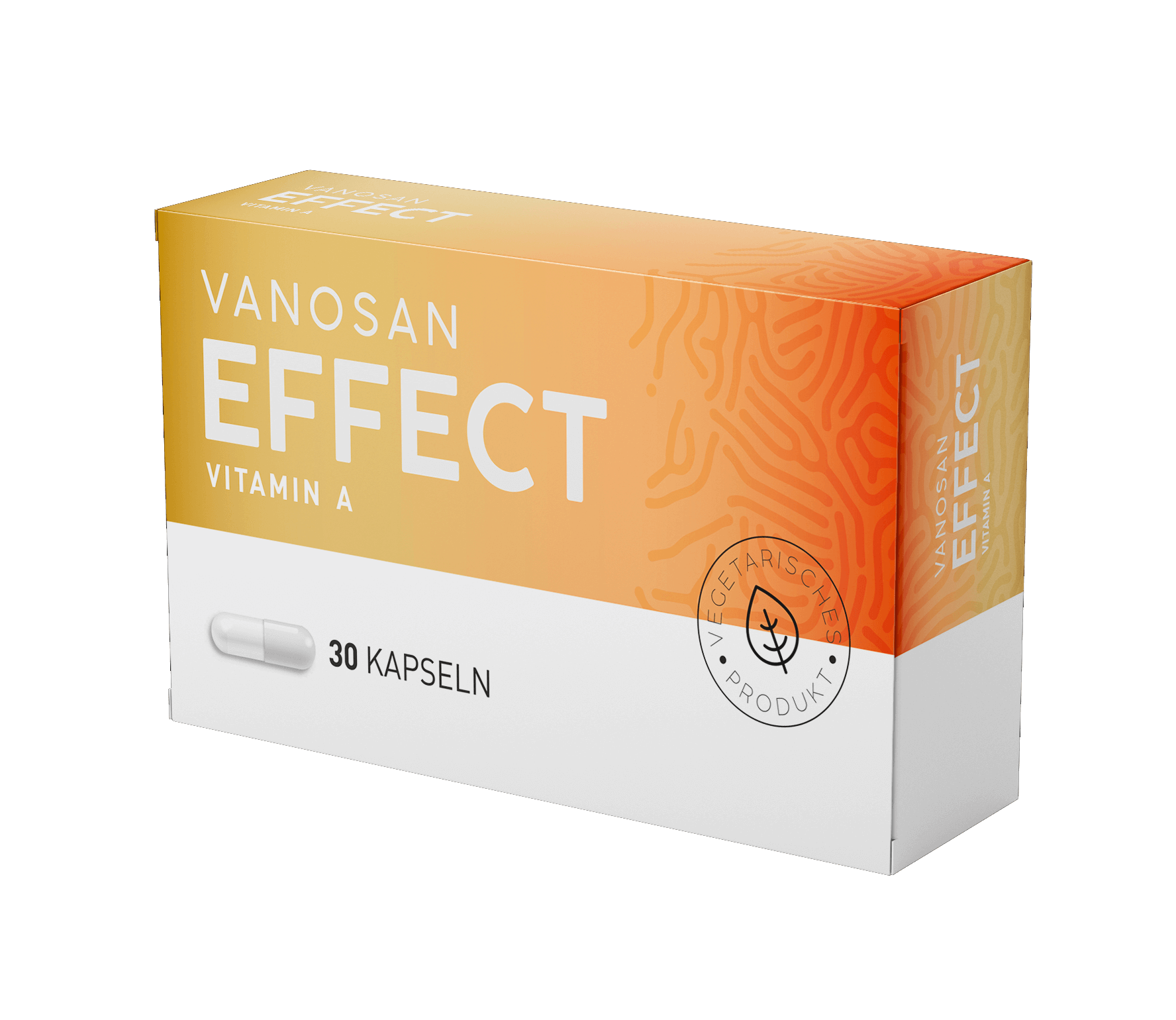
Vanosan Vitamin A
by VANOSAN
Pros
- Daily dose contains 2,000 µg of vitamin A
- Free from soya and gluten
- Vegan
- Laboratory-tested
- Few additives
- Two-month supply
Cons
- Only available online
- No enhanced bioavailability
Verdict
Vanosan Vitamin A contains retinyl palmitate, a stable form that the body stores well and reliably converts into active retinol. The dose is sensibly chosen and in line with recommendations for a safe but effective daily intake.
The formula is free from unnecessary additives, which is a particular advantage for people with sensitivities or allergies. The vegan capsule shell is another plus.
On the downside, some customers find the capsules rather large, which makes taking them every day harder. Another drawback: the pack gives little further information on exactly how the product works or on possible interactions, something people increasingly expect from supplements.
It is made in Europe and is usually dispatched within 1–3 working days.
The recommended dose is two capsules a day.
Each pack contains 120 capsules.
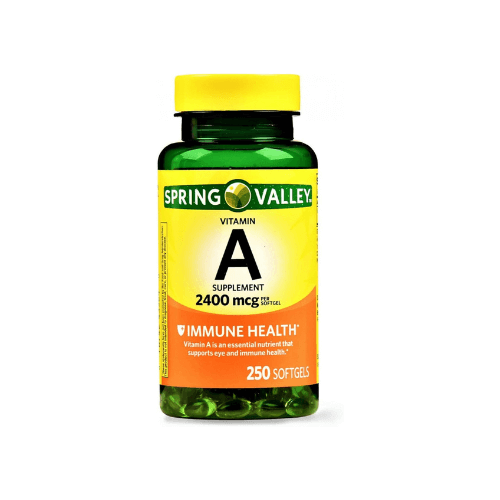
Spring Valley Vitamin A
by SPRING VALLEY
Pros
- Laboratory-tested
- Retinyl palmitate, an active and readily absorbed form
- Tested for contaminants
- Few additives
- Good manufacturing quality
Cons
- Contains animal gelatine
- Only available online
- Dose below the recommended maximum
- Users report headache-like symptoms
Verdict
Spring Valley Vitamin A is a low-cost supplement aimed simply at covering your vitamin A needs. It contains 2,400 µg (8,000 IU) of retinyl palmitate per capsule, a standard form of vitamin A that the body can use well.
The large number of capsules (250 per pack) makes the product particularly economical and attractive to anyone on a budget.
The product has solid certification, but the animal-derived ingredients, the relatively high single dose and reports of intolerance mean that in many cases it is not the best choice, especially for vegans, discerning buyers or anyone with a sensitive stomach.
Each pack contains 250 capsules.

Your eyes turn light into images, and vitamin A provides the key: it forms rhodopsin, a light-sensitive pigment that lets you see even in the dark.
Eyes: clear vision with vitamin A
Vitamin A is indispensable for your eyes to work properly. It supports the structure of the retina and helps process light signals correctly, especially at dusk. A vitamin A deficiency can lead to dry eyes, night blindness or increased sensitivity to light. So getting enough vitamin A doesn't just mean better vision: it may also help reduce the risk of age-related eye conditions such as macular degeneration. The result is clear vision, day and night.
Immune system: strengthening your natural defences
Vitamin A supports the body's first protective barrier: your mucous membranes. Whether in your airways, in your gut or on your skin, healthy mucous membranes protect against germs and harmful substances. At the same time, vitamin A regulates the activity of immune cells, which strengthens your body's natural defences. Especially in the colder months or if you're more prone to infections, getting enough vitamin A may help you stay healthy and recover faster.

A balanced vitamin A level makes you immune. At the very least, it strengthens your mucous membranes, your body's protective barrier against germs and bacteria.
Cell protection: for healthy-looking skin
Vitamin A promotes the formation and renewal of skin cells, which makes it a popular active ingredient in anti-ageing and acne products. Taken internally, it also has a positive effect on the skin: it supports the formation of new collagen, gives a smoother complexion and may ease inflammatory skin problems. People with dry, flaky or blemish-prone skin benefit most from getting enough vitamin A.
One study confirmed this: a large number of acne patients took high doses of vitamin A (retinol) over several months. After two to three months, many participants had visibly clearer skin.
Our verdict: vitamin A, a little goes a long way
Vitamin A is one of the essential micronutrients that do far more than you might think at first glance.
It supports your eyesight, strengthens the immune system and keeps skin and mucous membranes healthy: in short, it helps keep body and mind in balance.
If you're stressed, tired or struggling with your skin, a well-planned intake can make sense. Retinyl palmitate, the stable, well-tolerated form of vitamin A that your body converts into active retinol as it needs it, has a particularly good track record here. In liposomal form, it can also be absorbed much better, because the delicate active ingredients are protected on their way through the digestive tract and delivered efficiently to your cells.
Vitamin A really is an all-rounder. If you want to strengthen your body in the long term, vitamin A is a natural, well-tolerated option.
Take a look at our recommendations and find the right product for your needs.
See the tried-and-tested vitamin A products* We may earn a commission from some of the companies featured. This is how we keep our comparisons free to read.
Some of these companies are our commercial partners.
Sources
1. https://www.bzfe.de/inhalt/vitamin-a-32761.html
2. https://www.ncbi.nlm.nih.gov/pmc/articles/PMC6121174/
3. https://www.dge.de/wissenschaft/referenzwerte/vitamin-a/
4. https://ods.od.nih.gov/factsheets/VitaminA-Consumer/
5. https://www.bzfe.de/inhalt/vitamin-a-32761.html
6. https://www.aad.org/member/clinical-quality/guidelines/acne
7. Modern Nutrition in Health and Disease, 11.ª edição (2014), coordenação: A. Catharine Ross et al.
8. https://ods.od.nih.gov/factsheets/VitaminA-HealthProfessional/
9. ibidem
10. https://www.dge.de/wissenschaft/weitere-publikationen/faktenblatt-vitamin-a/
11. ibidem